In the last blog we established that many of us will never know the full story of how our ancestors got to Birmingham or why they stayed. This is in part due to the often-traumatic nature of the experience. From persecution in the old country to the trip itself, parents often refrain from burdening their children with the horrors of their lives. As a result, stories are lost — and many of us have at most only bits and pieces of our ancestors’ sagas.
Historians, however, can reconstruct stories about people and their movements from so many bits and pieces. They can take these bits of data from you and me and stir them up with pieces from elsewhere to determine what life was like generations before we were born. This isn’t magic, of course. Years of experience, training, and rigorous methodology help combine these parts into a whole. And professional standards of research as well as the review of their work by colleagues help them come to conclusions that are neither simple nor biased.
We are quite lucky in this respect because Birmingham and its Jewish community are replete with exceptional historians and archivists. Scholars involved with Temple Beth El’s Civil Rights Experience, as well as historians like Melissa Young at the University of Alabama who are at this very moment uncovering what has been lost and correcting that which has been misconstrued about our Jewish community.
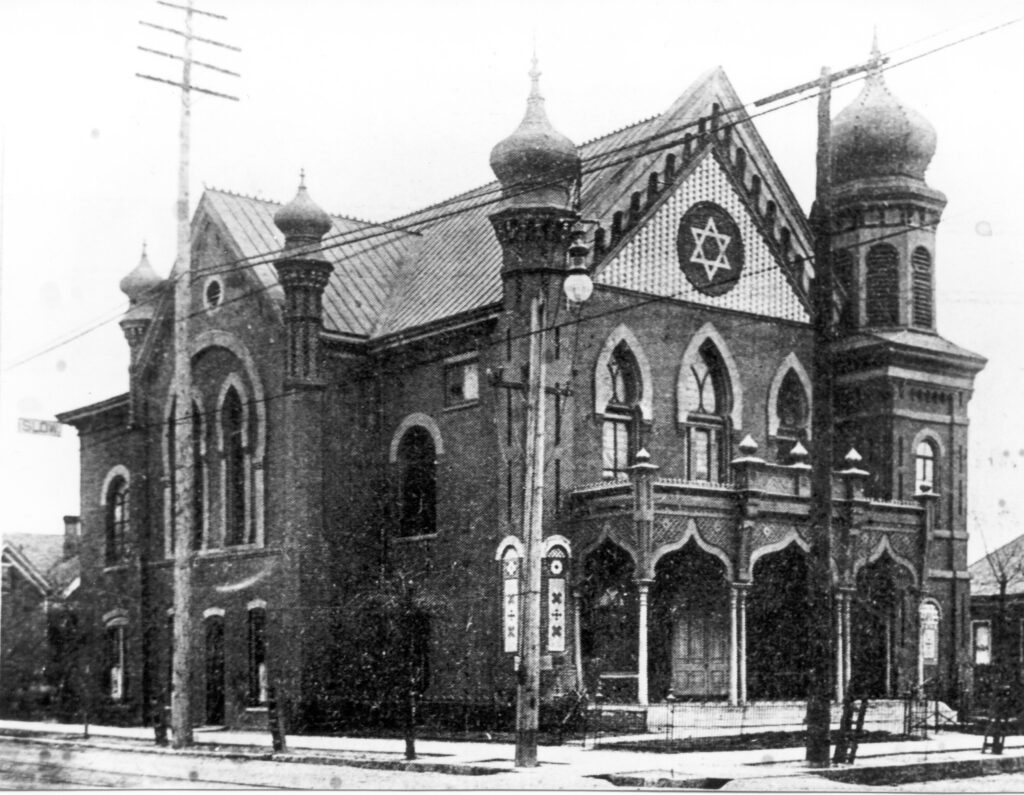
The original Temple Emanu-El building was located in downtown Birmingham. Founded in 1882, the congregation’s 85 families moved into their newly finished synagogue (at what is today 1629 Fifth Avenue North) in January 1889.Courtesy Birmingham, Ala. Public Library Archives.
Correcting is a key word here because much of what we thought we knew about our past is not entirely accurate. As startling as it may sound, some facts that we had learned about the Jewish community 30 years ago are now no longer considered to be true by historians. Even in this modern age, hateful conspiracies and selective reporting continue to affect how we are seen by others. Arguably just as damaging as the narratives created by antisemites are the fallacies we ourselves created and/or have embraced about our ancestors and ourselves.
When discussing the Jewish history of Birmingham it is important for us to ask the following questions: What do we commonly consider to be true about our community’s past that isn’t? In what way do these misconceptions affect how we view the people of the past? How does all this affect us today? And finally, what caused these fallacies to develop in the first place?
I would like for you to keep these questions in mind as you read the next few blogs in this series. Our topic, the “German Jews,” are a group that have become more a people of myth than of history. With the help of historians and other resources, we can develop a better idea of who they were, how they acted, and what reflections of their character we are blessed with today. Furthermore, by examining these pioneers we will start to understand why there are Jews in Birmingham, Alabama.
The ‘German’ Jews
When talking about the origins of Birmingham’s Jewish community, it is important to note that Jews have been present in Alabama since before it was even a state. For example, Abraham Mordecai settled in what is now Montgomery in 1783, and the Jewish community of Mobile can be traced all the way back to 1820. So it’s not exactly surprising that upon its founding Birmingham had Jewish residents. In fact, we know of at least three Jewish families who had already moved to the city before or right after the first train rumbled into Birmingham on the South & North Alabama Railroad on November 6, 1871: the Simons, the Marxes, and the Hochstadters.
It has also been established that these first Jewish pioneers and the majority of Jewish residents of Birmingham in those early years were all members of the second mass migration of Jews to America. This group, once known as the German Jewish Migration, has been astonishingly misrepresented in both the history books and our own lore for the past 200 years. Historians who now refer to this group as the “Central European Jewish Migration” only have to point to the deeply entrenched stereotype of the German Jewish Immigrant to demonstrate our mischaracterization of these early Americans.
The stereotype
In her book A Time for Gathering: The Second Migration 1820-1880, historian Hasia R. Diner lays out the stereotypical description of the German Jewish Immigrant before dismantling it point by point:
“The familiar figure of the mid-nineteenth-century American Jew portrayed a successful man of German origin who, devoted to German language and culture, participated fully in German American life. His connection to Judaism and the Jewish people eroded dramatically as he became integrated into the staid comfort of Victorian America.”
Apparently, none of this is true.
Dismantling the stereotype
For generations it has been assumed that this wave of jews, which extended from 1820 to 1880 was primarily German in origin. “Germans” or Jews emigrating from German-speaking states likely made up a slim majority of this period’s Jewish immigrants. Most of these individuals were from specific regions in the southern and western German states like Bavaria and Hesse. A large portion also came from the Prussian territory of Posen, which just five years prior to the start of the mass migration in 1820 had been Polish territory. Even within this group of “authentic Germans,” an unknown number were actually immigrants from Eastern Europe who stopped only briefly in Central Europe before being “strongly encouraged” by German officials to emigrate to the United States.
These refugees, although recorded in the census as residents of the German states, were actually from a vast array of places including Poland, Bohemia, Moravia, Galicia, Alsace, Hungary, Lithuania, and even the shtetls of Russia. We see this pattern reflected in early Jewish Birmingham. For example, while early resident Samuel Marx was born in Bavaria, Adolph Bernard (A.B) Loveman and Rabbi Morris Newfield were both born in Hungary. Similarly, while Samuel Ullman, a unifying leader in Birmingham’s early Jewish community, might have been born in a German state, he spent nine out of his 10 years living in Europe in the jewish community of Alsace, France.
This picture is further muddled by the fact that immigrants and American officials regarded Germans with higher esteem than immigrants from Eastern Europe. Knowing this, many jews from Poland and elsewhere lied about their origins to officials. A common way to do this was for immigrants to report to officials that they were from England or the Netherlands — way stations for Polish and other Eastern European Jews coming to the United States.
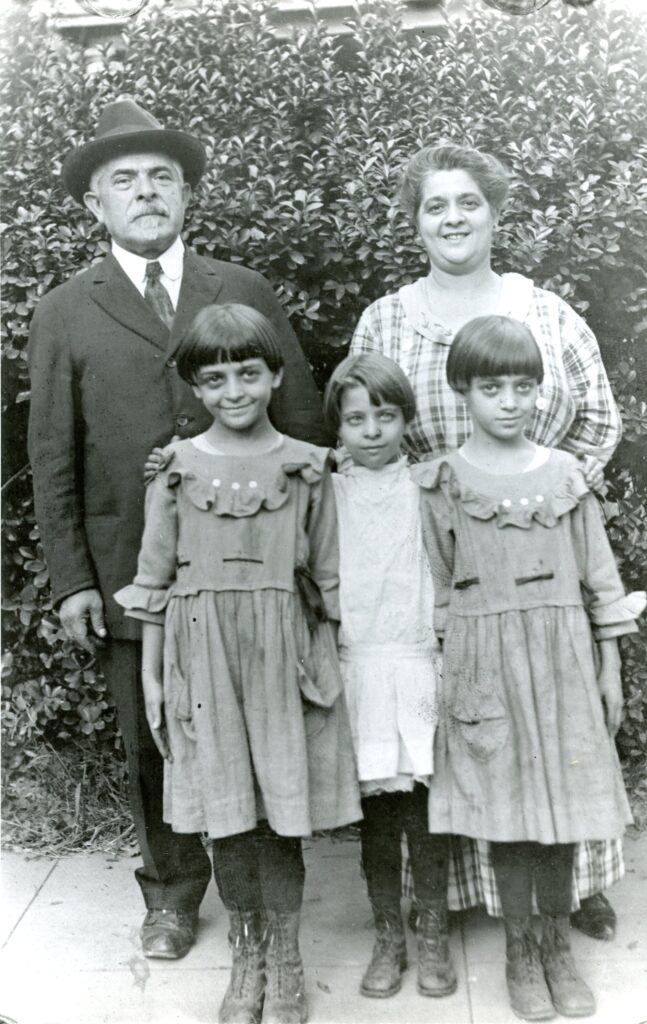
Although Birmingham’s Kurman family pictured here were Russian/Polish Jews from the third major Jewish immigration wave, many of the second migration wave’s “German” Jews were also from Eastern Europe.Courtesy Birmingham, Ala. Public Library Archives.
Another common method to hide an Eastern European origin was to report only the nation and not the city or region from which one emigrated. For example, Bernard Wellmann, who according to Elovitz was the proprietor of the first store that exclusively sold clothing in Birmingham, was reportedly born in Prussia; however, “Prussia” was often used as a stand-in for Posen or Silesia, and the Jews of these territories, annexed from Poland by Prussia, were unquestionably Polish. The same could be said about Jews from Galicia reporting that they were from Austria. According to Dinar, simply speaking a little German to the immigration officials could have been cover enough for Slovakian or Bohemian Jews to pass as Germans.
Men only?
Another misconception was that the Jews who made up this second migration were almost entirely men. Historians of central European Jewry have identified that many of the immigrants during this 60-year period were not men at all but women. Diner notes that up to 40 percent of those coming in the later years of the migration were single unmarried women. For example, in Bavaria between the years 1830 and 1839, a little under half the Jewish emigrants were women.
The migration pattern that these women followed is also quite interesting. During the first decade of the migration period it was mostly single Jewish men who traveled to America, but this gender divide evened out in later decades. In fact, the migration of unmarried Jewish men was followed closely by the migration of unmarried Jewish women. Even more fascinating is the fact that these Jewish women often emigrated alone, or when not alone in brother-sister pairs.
On arrival in America they were not simply married away but found and filled a wide variety of unexpected occupational niches that fit with their skill sets. They were in this respect neither wives nor mail-order brides but, like their male counterparts, refugees escaping the wars, poverty, and crushing antisemitic restrictions of Europe for better lives in America.
Wealthy, affluent, and successful?
Explaining how and how a few of these immigrants became wealthy will be detailed in another blog, but it is important to know that the wealth of these immigrants was not brought over with them. The “German” Jews who emigrated during this time period were typically those on the lowest economic rung of European Jewish society. They were the Dorfjuden (rural village Jews), the destitute, and the recently arrived Eastern European refugees. The poverty among this group was so profound that one contemporary account questioned if “their forefathers could not have been poorer when they were slaves in Egypt than are these depraved people in their wretched huts.”
It is important to highlight that their poverty was not a result of these individuals’ ineptitude or them being schnorrer | beggars. The poverty endemic in these Jewish communities was the purposeful actions of those who sought to promote Jewish emigration. In these Central European nations, where Jews were viewed with contempt, antisemitic restrictions on marriage, movement, employment, and occupation provided no room for Jews to prosper. Immigrants from Eastern Europe skilled in tailoring and brewing were similarly unable to engage in their crafts in the German states. Many had to choose between becoming beggars or leaving for better socioeconomic conditions.
The same restrictions in Europe that thrust so many into abject poverty also resulted in a large percentage of these Central European Jews working in trade-related occupations. In these states, Jews acted as middlemen who would travel long distances to purchase goods from various producers and sell them to interested buyers. Poor merchants would peddle or buy goods from peasants and sell them in urban centers. The wealthier established traders were often hired as agents by the government or industrialists to purchase horses for cavalry or raw materials for manufacturing. Sometimes Jews would have enough capital to establish small shops to sell collected goods from there.
In the German-speaking states, working as petty traders did allow for Jews to make a living, but it came with considerable risk. The most obvious was that this occupation required travel in states that regulated and restricted Jewish movement. Another was in the fact that some German states made it illegal for Jews to sell goods to Christians. Having all of their wealth tied up in trade also meant that Jews were at considerable risk if their wealthy and/or government buyers demanded goods at an untenable price or refused to pay their bills. The frequent conflicts in Europe as well as antisemitic violence destabilized trade networks and made a risky occupation into a potentially deadly one.
Finally, while Jews did participate heavily in trade, it is an occupation with limited room plus starting costs that were sometimes out of the reach of village Jews — and especially eastern immigrants who as day laborers could dream only of being a peddler.
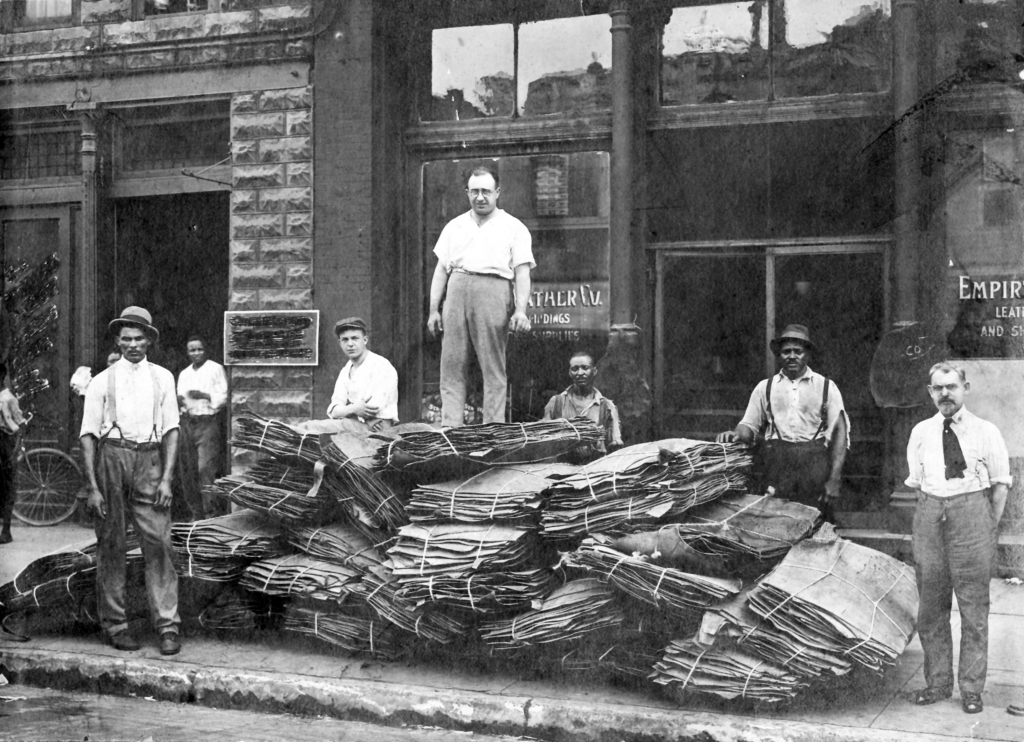
David T. Fiedelson stands atop a pile of bundled hides in front of his Empire Leather Company in Birmingham. Stores like this one were often established by successful Jewish merchants who had found a particular trade niche like dry goods, furniture, or — as in this case — leather and leather working supplies.Courtesy Birmingham, Ala. Public Library Archives.
Germanized?
Another fallacy that needs to be corrected is that German Jews fleeing to America were notably not Germanized. In fact, Diner states that the German and Russian Jews were more similar in their culture and behavior than they were different. While we don’t have the space to go into all the details about this, there are four points that are key to understanding what this means.
First, in Central European society Jews were seen as outsiders who didn’t fit into the social structure of the state. Even those living in German states for generations were not actually German in the eyes of the state. Antisemitic writers of the time deemed Jews as aliens living among proper Germans. They complained that they were too adherent to their religion, insular, solely focused on Jewish interests, spoke in a foreign language (Yiddish), and were suspiciously concentrated in only certain occupations. Figures across all levels of German society openly promoted fallacious racial stereotypes that portrayed the Jews as a race of morally corrupt, greedy, and/or deceitful people.
However, the Germans, unlike their counterparts in tsarist Russia, felt that at least some Jews could be improved, or Germanized, through the destruction of their culture, forced reeducation, and integration.
Second, prior to emancipation, Jewish life was controlled by both oppressive German law and the rule of state-sanctioned Jewish communities called kahal. The kahal legally controlled all aspects of Jewish life, including education, religion, taxation, and social welfare, resulting in notable interdependence as well as an enforced level of homogeneity most of us would find startling. Under these oppressive overlapping systems of governance, Jews of different communities lived quite similarly to one another but notably differently from their Christian neighbors.
Third, in the 50 years between 1820 and 1870, Jews were slowly granted rights as citizens in the German states. This process, called emancipation, varied from state to state and had many starts and stops along with a plethora of notable champions as well as violent opposition. It also came with a price tag. In exchange for these freedoms, the German governments exerted more power over the Jewish communities and Jewish life. Through the control of the kahal as well as other legal means, German officials engaged in a campaign to germanize the Jews by destroying their “cultural distinctiveness.” They did this by slowly dismantling Jewish institutions, enforcing secular education, and even outlawing or restricting emancipation to Jews who were engaged in certain trade-based occupations.
However, the Germans, unlike their counterparts in tsarist Russia, felt that at least some Jews could be improved, or Germanized, through the destruction of their culture, forced reeducation, and integration.
Finally, what’s important to understand here is that due to the logistics, patchwork application, and the timeframe in which this Bildung, or improvement, occurred, it did not reach the little villages and rural hamlets of the early Jewish emigrants until after many had left for America. Therefore, even the Jews born in Germany, raised in Germany, and emigrating from Germany were, outside of knowing the language, notably ungermanized.
It wasn’t until the later years of the migration that the effects of German control over the Jewish community would be clear. By that point, most of the poor rural Jews had left for America while the remaining had made their own mass migration to major urban centers throughout the German states. These German Jews, being comfortable as emancipated middle-class citizens of the German Empire, were overall less likely to emigrate.
The only major exception to this was the German rabbis brought over by American congregations that could afford to do so starting in the 1840s. The German rabbis were forced to conduct services in German and have a secular education in the urban centers of Germany. As Jonathan Sarna points out in American Judaism: A History, when they arrived in America, many caused considerable consternation as they transformed and challenged new and long-established congregations across the country.
Reform Jews quickly abandoned their religion?
This brings us to our final fallacy: that the “German” Jews were areligious and/or primarily followers of Reform Judaism. While this is once again a topic we will cover more extensively at another time, I would like to highlight that these refugees from the Central European wave practiced a stream of Judaism that was most similar to Orthodox Judaism. In the early part of the migration, many of these Jews residing in major American port cities joined established orthodox Sephardic congregations. As the century progressed, these immigrants set up numerous traditional orthodox congregations across America, challenging the fallacy of the German Jews being all Reform or areligious. The large number of conflicts within the Jewish communities over how to practice Judaism that erupted during this time period also highlights the continued focus these Jews had on their faith.
Even as these immigrants moved into the hinterland where Jews were scarce and mobile, most did not give up their religious identity. Without the oppressive laws of the state and/or the kahal, and faced with the incredible vastness of the United States, Jews had the opportunity to abandon Judaism without legal consequences. Instead, they struggled to maintain the same religious practice that they did in Europe. Adaptations were made to maintain their connections to God and the Jewish people. We can see this quite clearly in the history of our own reform congregation Tempel Emanu-El.
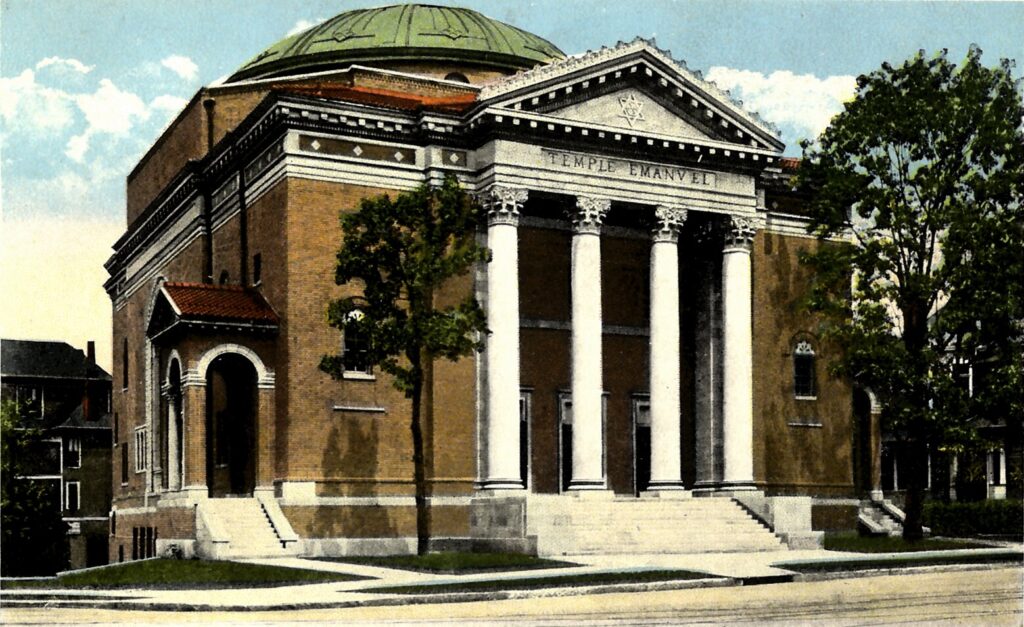
After its membership swelled to some 300 families, Temple Emanu-El built a new home at its present location on Highland Avenue. Courtesy Birmingham, Ala. Public Library Archives.
Where is this stereotype from?
A portion of the blame for this stereotype belongs to historians. The professional study of Jews in America is a rather recent development, and standards of research for this particular topic did not reach current levels until the later half of the 20th century. Diner states that even then, most of the researchers were the children and grandchildren of Eastern European immigrants who grew up with “stilted portraits” of the American Jews from this wave. Mischaracterizations of “German” Jews popular in the culture of the time pervaded their work, resulting in an acceptance of the perspective that these Jews had integrated into America “at the expense of their Judaism and Jewishness.”
Arguably an even bigger factor in the development of this stereotype were contemporary views of “German” Jews that became solidified in American culture. The time period in which these immigrants arrived was one in which America was still defining itself. Faced with conflicting values such as agrarianism vs. urbanism/industrialization, multiculturalism vs. nativism, and evangelism vs. religious liberalism, minorities served a purpose of definition and reflection of the majority white culture. Jews, being legally white and “knowable” (due to Christian familiarity with the Torah), became especially useful in illustrating these conflicts through juxtaposition.
In contemporary sermons, political speeches, newspaper articles, and novels, etc., Jews became “emblematic of everything one liked or disliked about America.” Just like current antisemitic rhetoric, much that which was said was contradictory, with each fallacious accusation serving to illustrate a point about current cultural conflicts.
So, for example, Jews were used to illustrate sides in the conflict between Jeffersonian ideals and those of Hamilton. Individuals would praise Jewish business acumen in one article and then label these same individuals as being unfair, untrustworthy, and parasitic in the next. Similarly, Jews were depicted as strange “others” who would ruin the character of the country, but then the acceptance of Jews into communities was written about as being deeply American expressions of religious tolerance and multiculturalism. Even when discussing the liberalism of the Jewish Reform movement over the “outdated theology” of the Orthodox movement they complained of Judaism’s subsequent loss of “ancient character.”
Next time
In coming blog installments, we will discuss why the Jews of the Central European wave left Europe and the physical trip they took to get to Birmingham. Then we will delve into the details of how the Jews of this second wave helped shape Birmingham into a hospitable home for the third migration: the Eastern European Jewish wave.
I hope that by providing you with a better understanding of these early “German” pioneers and dispelling some of the fallacious assumptions about them, you will be able to appreciate what incredible things they were able to achieve and why they made Birmingham their home.
Sources
Diner, Hasia R. A Time for Gathering: The Second Migration, 1820-1880. Johns Hopkins University Press, 1992.
Elovitz, Mark H. A Century of Jewish Life in Dixie. University of Alabama Press, 27 Mar. 2003.
Howe, Irving. World of Our Fathers: The Journey of the East European Jews to America and the Life They Found and Made. New York, Open Road Media, 2017.
Mendelsohn, Adam. The Rag Race : How Jews Sewed Their Way to Success in America and the British Empire. New York ; London, New York University Press, 2016.
Rabin, Shari. Jews on the Frontier. NYU Press, 12 Dec. 2017.
Sarna, Jonathan D. American Judaism: A History. 2nd ed., Yale University Press, 2019.
Young, Melissa. Received by Zachary Dembo, 26 Aug. 2024 to 13 Sep. 2024
About the author
Zachary Dembo is a Licensed Professional Counselor and Southern Jewish history nerd from Baltimore, Maryland — the Birthplace of the Star-Spangled-Banner. His first of many visits to Birmingham began in 2008 and he became a resident in 2019. He is married to Lauren Axelroth, a third-generation Birminghamian.