
The Garden
A little garden.
Fragrant and full of roses.
The path is narrow
And a little boy walks along it.
A little boy, a sweet boy,
Like that growing blossom.
When the blossom comes to bloom,
The little boy will be no more.
—Franta Bass, Child of Terezin
By Richard Friedman
The simplest of settings can have the most powerful impact. This was proven to me once again as I walked the Levite Jewish Community Center’s outdoor track Monday evening on a beautiful spring night.
I had just left a great Yom HaShoah Holocaust remembrance at The J. It was a collaboration between Birmingham’s Jewish agencies and synagogues. In her closing, The J’s CEO Brooke Bowles urged people to journey to the track for the Meditation Walk. I took her up on the suggestion.
There, constructed in a brilliantly understated way, was what turned out to be one of the most powerful Holocaust remembrance exhibits I have experienced. The project was designed by Zoe Weil, director of special projects at The J and a Holocaust studies teacher at the University of Alabama at Birmingham. Strategically placed on the circular track were colorful posters highlighting poems by children imprisoned at Terezin and later murdered at Auschwitz.
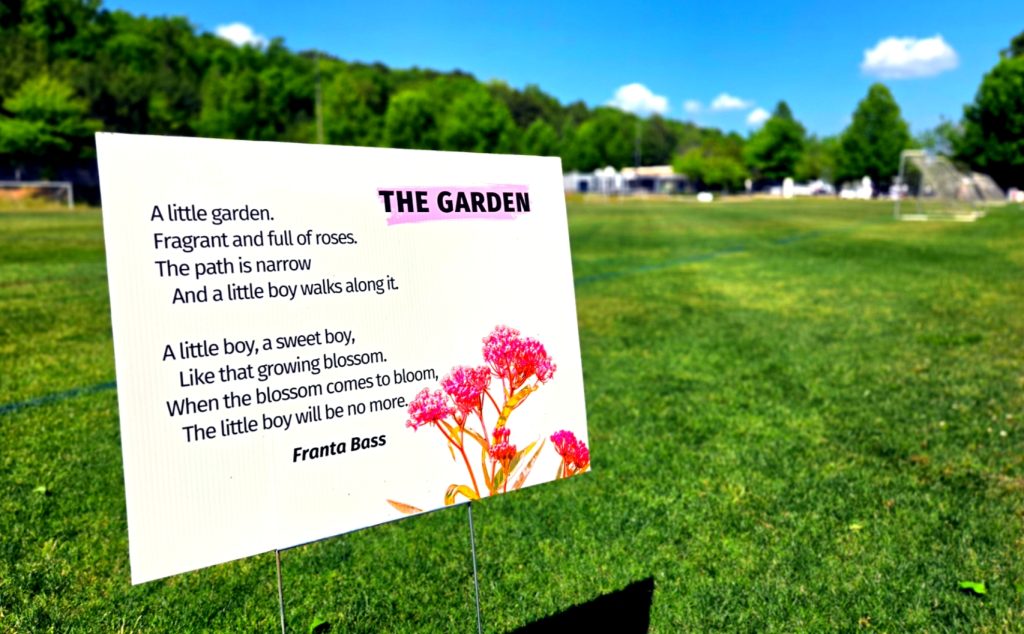
The exhibit will continue through Friday, April 24.
Terezin was a Nazi-run transit ghetto-camp in Czechoslovakia from 1941 to 1945. “Some 15,000 children under the age of 15 passed through Terezin. Fewer than 100 survived,” a poster explained. My wife Sally and I visited Terezin last summer. It was a chilling experience on a brutally hot day.
One of the most piercing remembrances we have of the Holocaust are poems written by children held captive at Terezin. It was there that Franta Bass, a young Jewish boy, was imprisoned; it was there that he wrote “The Garden,” the poem highlighted above. Franta was born in Czechoslovakia. He was sent to Terezin in 1941, at age 11. He was deported to Auschwitz in 1944 and murdered two weeks after he arrived.
Suspended in stillness
As I began walking the track and reading the other posters — which included the background and fate of the child who had written the poem — I became increasingly mesmerized. I paused, overwhelmed with emotion, and texted Brooke: “I’m on the walk as I write this. It is so well done and riveting. As I’m walking and reading the posters, I’m picturing these kids, many the same age as my grandchildren, trapped at Terezin. Thank you to The J for doing this. I wish everyone in our community would walk this walk.”
I kept moving forward, around the far end of the track, slowly, suspended alone in stillness — despite the noisy, crowded soccer fields — reading the poems of child after child. As I walked, I imagined myself on the streets of Terezin in 1943, walking amid the confusion and creeping sadness in the eyes of the children.
I paused and again texted Brooke: “As I’m walking, the fields are full of boisterous soccer players. It is so jarring because metaphorically it reminds me of all those places in Europe where ‘ordinary people’ went about their business — playing games and enjoying life — as Jews were being murdered by the millions.”
A soccer ball rolls onto the track. I kick it back onto the field.
I walked some more on this clear gentle night, along the stretch of track overlooking Montclair Road, remembering our visit to Terezin. The hidden synagogue we saw, with Hebrew on the wall expressing a yearning for the Land of Israel, flashed across my mind. So did a sweltering cramped room filled with bunkbeds.
Perhaps it was in this room that a child known only as Teddy wrote the following:
At Terezin
When a new child comes
Everything seems strange to him.
What, on the ground I have to lie?
Eat black potatoes? No! Not I!
I’ve got to stay? It’s dirty here!
The floor – why, look, it’s dirt, I fear!
And I’m supposed to sleep on it?
I’ll get all dirty!
Here the sound of shouting, cries,
And oh, so many flies,
Everyone knows flies carry disease.
Oooh, something bit me!
Wasn’t that a bedbug?
Here in Terezin, life is hell
And when I’ll go home again, I can’t yet tell.
Richard Friedman is the retired executive director of the Birmingham Jewish Federation and Levite Jewish Community Center. The poems displayed are from I Never Saw Another Butterfly: Children’s Drawings and Poems from Terezin Concentration Camp.