By Zachary Dembo
This is the third installment of a three-part series that recounts a driving tour of Jewish Birmingham that lifelong resident Milton Goldstein gave to amateur historian Zachary Dembo in the spring.
Birmingham’s old retail district should for all intents and purposes be considered another historic Jewish space in the city. Filled with Jewish-owned and -operated businesses since the city’s founding, it became a place where many if not most of the city’s Jews spent a portion of their lives. It was also a place where the “German” Jewish proprietors of massive department stores (referred to in part II), and who lived in Southside mansions, worked alongside the Eastern European clerks and peddlers who resided in the congested north side Jewish ghetto.
It was also a place where many Birminghamians had their first interaction with a Jew. This would have been quite a novel experience, especially in the Deep South where “Hebrews,” as we were commonly referred to, were few and antisemitic perceptions were the norm. In fact, during the foundational years of the city it was more common to use the word “Jew” as an insult toward another gentile than to use it in reference to one of the city’s children of Avraham.
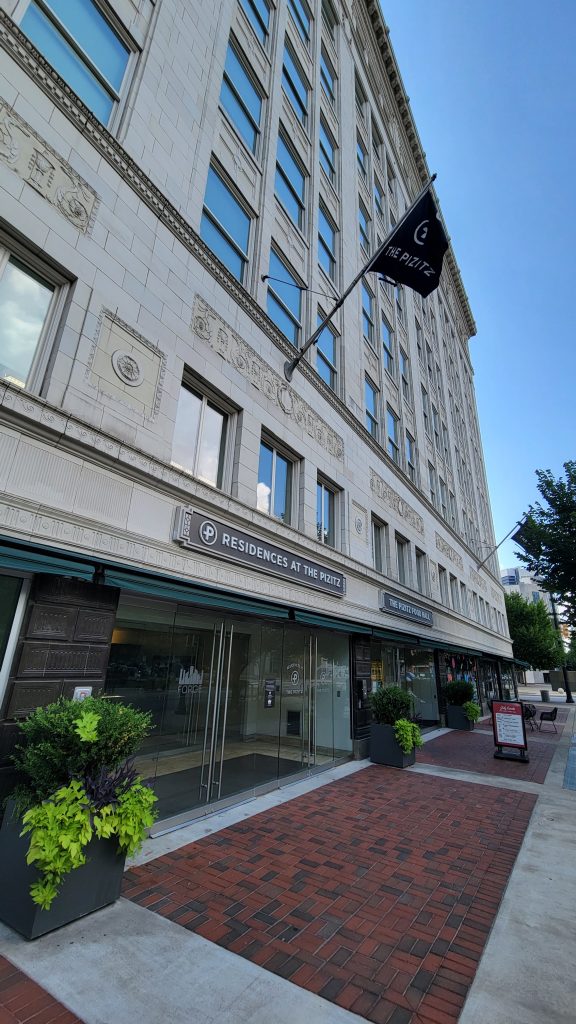
For these reasons, many successful business interactions downtown started with the realization by the customer that while some Jews might have spoken with a “weird” accent, they in fact had no devil horns upon their heads. To their surprise, Jewish clerks were gracious, kind, and respectful. Perhaps most importantly, almost everyone who interacted with figures such as Louis Pizitz and/or his employees came to discover that, despite the stereotype, Jews were not out to cheat and rob them.
As a result, in Birmingham at least, the word “merchant” became a synonym for Jew, and the Jewish community as a whole became known as “the Merchants.”
Milton, our guide, was well aware of the disposition of the retail district and the importance it had in the fortunes and lives of Birmingham Jews. When Milton returned from his service in Vietnam he got a job in Rich’s Department store in Atlanta. After starting their executive training program he became a buyer. Then when Golbro opened its first branch store, the family asked him to move back to Birmingham and help manage it.
During his lifetime he witnessed more than one transformation of the district, including the changes brought on by the civil rights era and the collapse of the local mining and steel industries.
Morris Avenue peddlers
The history of the Jews in the retail district started on Morris Avenue, where an area called the railroad reservation saw the area’s first Jewish peddlers and merchants set up temporary shops. As they waited for more permanent locations for their stories to be built, these entrepreneurs sold their wares to other young pioneers living in the sea of tents and makeshift shanties that surrounded the newly laid railroads.
Over the next 30 years an incredible transformation would occur in Birmingham — not just in the size and population but also in the types and numbers of Jewish-owned businesses. As the city boomed, many of the original Jewish dry good merchants like Isaac R. Hochstadter, perhaps weary of competing with one another and seeing a major demand, switched to the liquor trade. All along first and second avenue these Jewish pioneers established some of the city’s first saloons, billiard clubs, liquor wholesale shops, and even beer bottling operations. Selling liquor and in particular whisky would be a popular Jewish occupation in Birmingham until it was outlawed in 1915.
The most enduring Jewish place in town
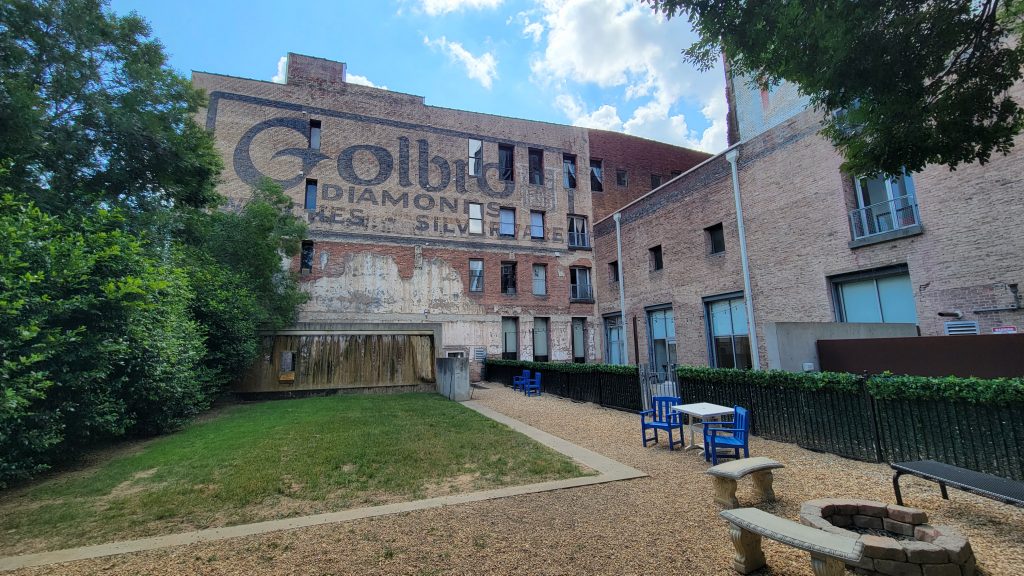
Milton, however, is not 125 years old (and between you and me he doesn’t look a day over 71!). His experience of Jewish downtown wasn’t of the boom town but as it existed during the late 1940s, through the civil rights era, and into the 1990s. This was a period that many in our community would call the “golden age” of Jewish retail, where many of the long-established Jewish businesses like Parisians, Pizitz, Sokols Furniture, Loveman’s, Golbro, and others reached their peak. So that’s what he took us to see.
We spent about 30 minutes cruising up and down the streets that made up Birmingham’s old retail district, which from the 1870s to rather recently was the most enduring “Jewish” place in the city. Like many urban ethnic groups, the Jews of Birmingham moved around. At one point or another many lived on the north and/or the south sides of Birmingham before finally settling in the suburb of Mountain Brook. However, the retail district, or at least many places within it, stayed Jewish or in some way affiliated until the very end.
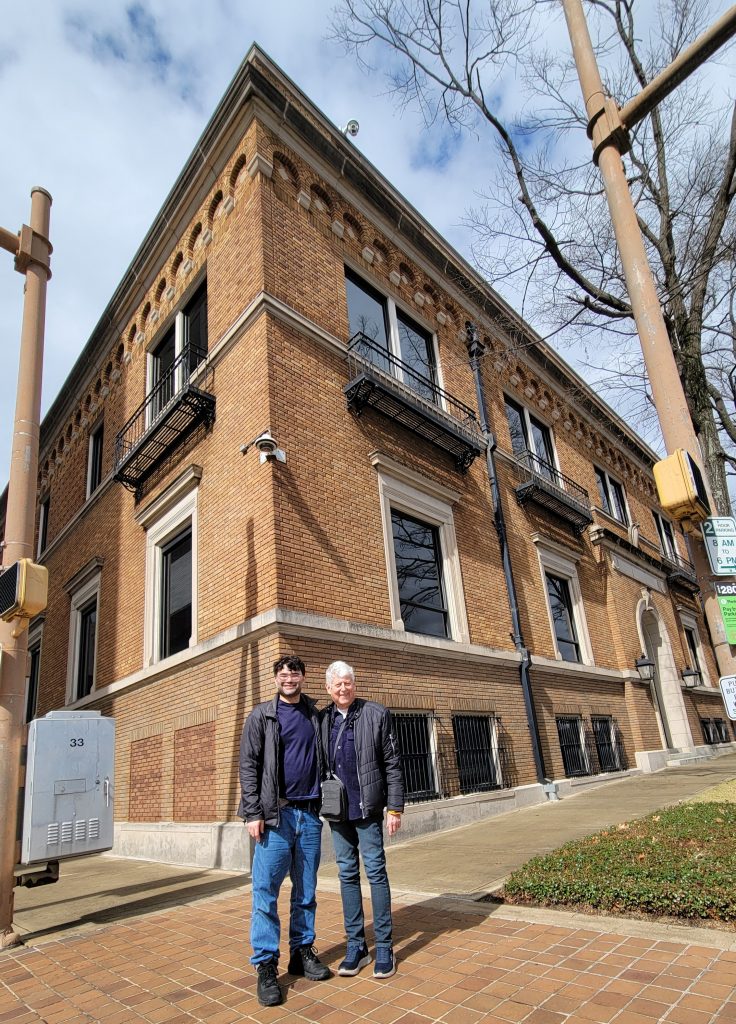
The most interesting example of this pattern of movement and belonging can be seen in our next stop, a building built in 1924 and located on the corner of 18th Street North and 7th Avenue North: the Young Men’s Hebrew Association. Established in 1887, dissolved due to the 1893 financial panic, and then reconstituted in 1906, the YMHA became the most important secular Jewish organization in the Jewish community. The many facets of Birmingham Jewry merged into community within its walls.
Then as Birmingham Jews moved to Mountain Brook, so too did the organization that had become the soul of their community. A new facility named the Levite Jewish Community Center was built at the edge of Mountain Brook on Montclair Road and opened in 1957.
Last stop
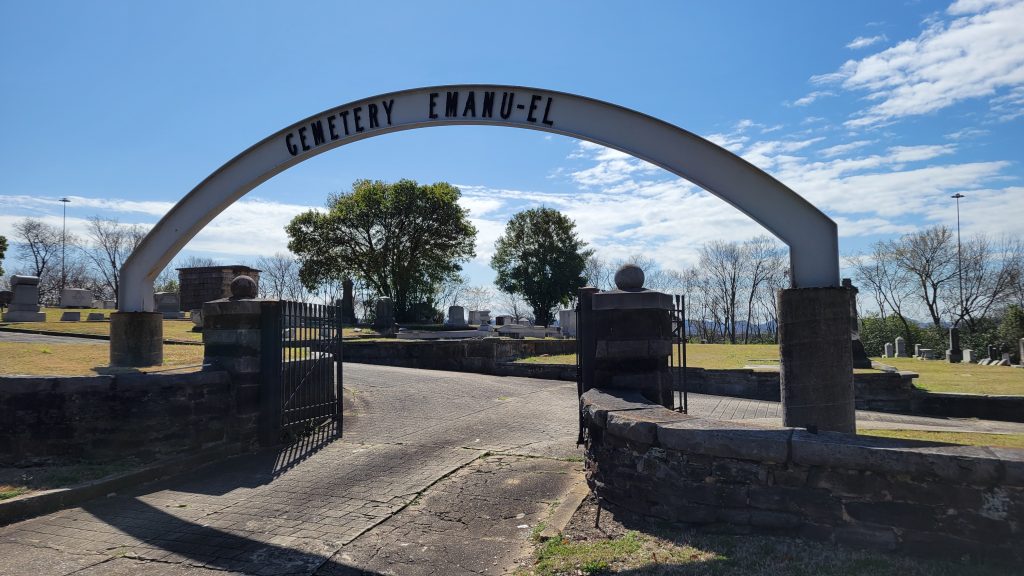
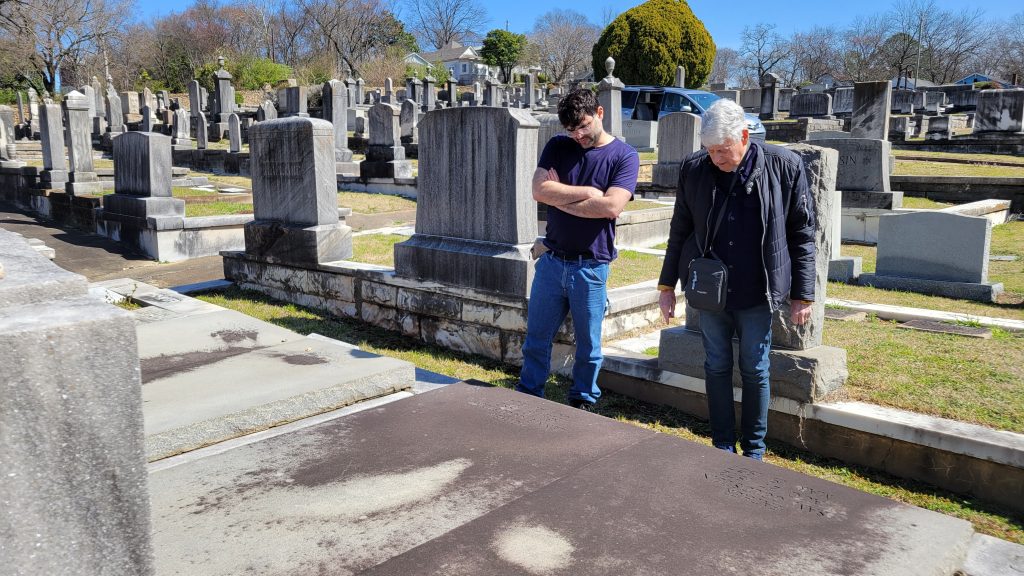
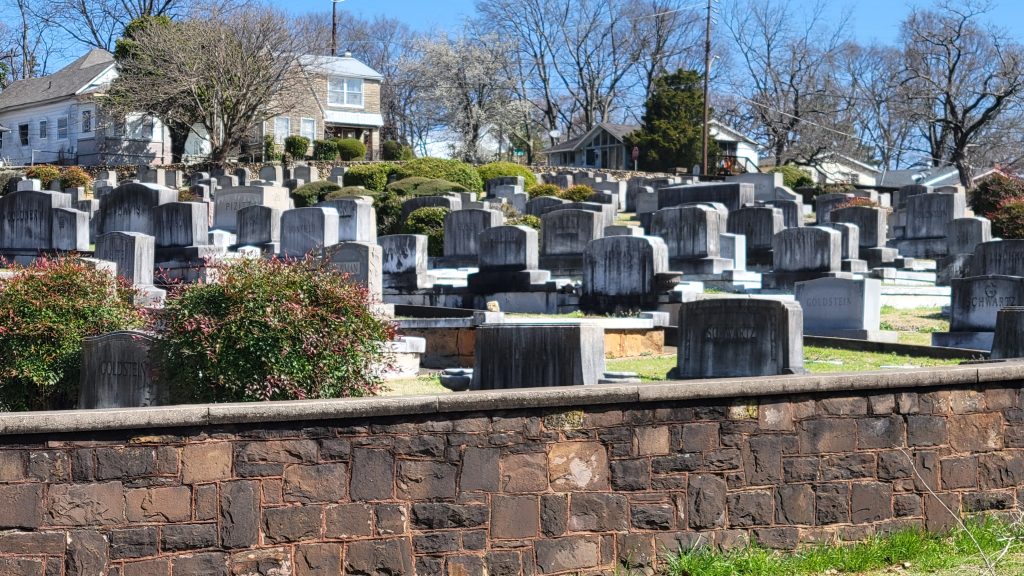
Home, work, recreation, and community. Having seen all four on our tour, Milton had only one thing left to show us — the first and most important communal investment by our city’s pioneering Jews: the cemeteries of Temple Emanu-El and Knesseth Israel Congregation/ Temple Beth-El, where life’s journey ended for many of the first Jewish citizens of Birmingham.

Zachary Dembo is a Licensed Professional Counselor and Southern Jewish history nerd from Baltimore, Maryland — the Birthplace of the Star-Spangled-Banner. His first of many visits to Birmingham began in 2008 and he became a resident in 2019. He is married to Lauren Axelroth, a third-generation Birminghamian.
In recognition of Zach’s historical writing for The J’s blog, in January 2025 he received the LJCC’s L’Dor V’Dor Award “for embodying The J’s core value of empowering others to learn and understand Jewish values, thereby ensuring a vibrant and meaningful Jewish future.”
Also by Zachary Dembo:
- Touring Jewish B’ham with Milton (part I and part II)
- Because we could: The history of Jews in Birmingham
- Of secrets, omissions, and selective memory
- How the ‘German’ Jews got to Birmingham: Part 1
- ‘I understand freedom more than you’: German Jews in Birmingham
Help with our history!
Let us know what you know and what you might want to know about Birmingham’s Jewish History by filling out the form below (only name and email are required). Your answers will be kept confidential and we will obtain permission from you before using any information you submit.